
CONTRIBUTION
SEEKING
DISTRIBUTION PARTNER
#104
Idea
Prototype
Market
Scaling
15 MINUTE RC WING Build | 250g
VALUATION
Valuation Restricted
Light and small DIY trainer Wing that can be built in about 15 Minutes. I know that the leading a...
Light and small DIY trainer Wing that can be built in about 15 Minutes. I know that the leading and trailing edges are flat but I just wanted to prove, that its not necessary.
READ MORE
OPEN REEL
CONTRIBUTION
SEEKING
DISTRIBUTION PARTNER
#64
Idea
Prototype
Market
Scaling
Mini conveyor with middle drive - FR-20-20-M
VALUATION
Valuation Restricted
Mini conveyor with middle drive - FR-20-20-M

SEEKING
OTHER
#187
Idea
Prototype
Market
Scaling
Car? No! Is it a bicycle? No Car+Bicycle= Quadvelo! Gas prices rising who cares as Quadvelo is here!
VALUATION
Valuation Restricted
I am amazed that i find Quadvelo - bicycle on 4 wheels covered meaning that is extremely similar ...
I am amazed that i find Quadvelo - bicycle on 4 wheels covered meaning that is extremely similar to a car isn’t it?
Like a smart tiny car but hey is a bicycle on the 4 wheels on Pony4 and is called Quadvelo. And it is a electric bicycle..and that Quadvelo will change the future of transportation...as I was always looking for a bicycle which is covered and you can use it in all weather conditions!
Because most of us don’t use bicycles when raining or snowing but now we don’t have those reasons anymore.
Quadvelo is for you because when is raining or snowing you can still just seat in your bike and go to the shop or on a longer trip…and you have enough room for you and your shoping a kid, or a dog!
Like a smart tiny car but hey is a bicycle on the 4 wheels on Pony4 and is called Quadvelo. And it is a electric bicycle..and that Quadvelo will change the future of transportation...as I was always looking for a bicycle which is covered and you can use it in all weather conditions!
Because most of us don’t use bicycles when raining or snowing but now we don’t have those reasons anymore.
Quadvelo is for you because when is raining or snowing you can still just seat in your bike and go to the shop or on a longer trip…and you have enough room for you and your shoping a kid, or a dog!
READ MORE
OPEN REEL
SPONSORED INNOVATION

Fashion for everyone. Know your fabric quality before you order...
Learn More
CONTRIBUTION
SEEKING
RAW MATERIAL SUPPLIERS
#112
Idea
Prototype
Market
Scaling
Agricultural Cultivator
VALUATION
Valuation Restricted
A cultivator is any of several types of farm implement used for secondary tillage. One sense of t...
A cultivator is any of several types of farm implement used for secondary tillage. One sense of the name refers to frames with teeth (also called shanks) that pierce the soil as they are dragged through it linearly.
Cultivators stir and pulverize the soil, either before planting (to aerate the soil and prepare a smooth, loose seedbed) or after the crop has begun growing (to kill weeds—controlled disturbance of the topsoil close to the crop plants kills the surrounding weeds by uprooting them, burying their leaves to disrupt their photosynthesis, or a combination of both).
Cultivators stir and pulverize the soil, either before planting (to aerate the soil and prepare a smooth, loose seedbed) or after the crop has begun growing (to kill weeds—controlled disturbance of the topsoil close to the crop plants kills the surrounding weeds by uprooting them, burying their leaves to disrupt their photosynthesis, or a combination of both).
READ MORE
OPEN REEL
CONTRIBUTION
SEEKING
OTHER
#162
Idea
Prototype
Market
Scaling
How to make Used Oil Mini Camping Stove Burner Version 2
VALUATION
Valuation Restricted
How to make Used Oil Mini Camping Stove Burner Version 2
SEEKING
MANUFACTURER
#142
Idea
Prototype
Market
Scaling
DIY 5 Speed Gearbox from Cardboard
VALUATION
Valuation Restricted
Amazing 5 speed gearbox DIY. In this video I will guide you gearbox build with 5 speed transmissi...
Amazing 5 speed gearbox DIY. In this video I will guide you gearbox build with 5 speed transmission from cardboard. This is a manual transmissio - RC 5 speed. Principle of operation of 5-speed gearbox:
Mode N: the gears of the middle axis \"are not attached to\" the gears of axis 3 (the inner axis, is attached to the motor), so the middle axis and the 1- axis axis in the outermost are not turned.
Mode 1: First gear (R = 3cm) (from left) of axis 3 \"attached to\" third gear (R = 3cm) of the middle axis and first gear (R = 2cm) of the middle axis \"attached\" to the first gear (R = 4cm) of the first axis (outermost axis) so that the reel rotates (the slowest speed).
Mode 2: Second gear (R = 3cm) of axis 1 \"attached to\" third gear (R = 3cm) of the middle axis and second gear (R = 2.5cm) of the middle axis \" attach to the \"second gear (R = 3.5cm) of the first axis (outermost axis) the rotating axis (faster speed than mode 1).
Mode 3: Third gear (R = 3cm) of axis 1 + third gear (R = 3cm) of the middle axis + third gear (R = 3cm) of the first axis (outer axis) \"attach to each other\" rotation axis (faster speed than Mode 2 and equal to the speed of motor).
Mode 4: Fourth gear (R = 3.5cm) of axis 1 \"attached to\" fourth gear (R = 2.5cm) of the middle axis and third gear (R = 3cm) of the middle axis \"attached to\" the fourth gear (R = 3cm) of the first axis (outer axis) the rotating axis (faster speed than mode 3).
Mode 5: Fifth gear (R = 4cm) of axis 1 \"attached to\" fifth gear (R = 2cm) of the middle axis and third gear (R = 3cm) of the middle axis \"mounted into the \"fifth gear (R = 3cm) of the first axis (outermost axis) the rotating axis (fastest speed)
it active amazing. Hope you like speed gearbox it. Thank you!
Materials you need: cardboard, 4 bearings, A4 paper, 1 motor DC 9v, 1 switch, battery, aluminum bars, hot glue gun and follow all steps from this video and you will get amazing #speedgearbox with #5speedtransmission. If you like this video don't forget to subscribe :). Thank you!
Mode N: the gears of the middle axis \"are not attached to\" the gears of axis 3 (the inner axis, is attached to the motor), so the middle axis and the 1- axis axis in the outermost are not turned.
Mode 1: First gear (R = 3cm) (from left) of axis 3 \"attached to\" third gear (R = 3cm) of the middle axis and first gear (R = 2cm) of the middle axis \"attached\" to the first gear (R = 4cm) of the first axis (outermost axis) so that the reel rotates (the slowest speed).
Mode 2: Second gear (R = 3cm) of axis 1 \"attached to\" third gear (R = 3cm) of the middle axis and second gear (R = 2.5cm) of the middle axis \" attach to the \"second gear (R = 3.5cm) of the first axis (outermost axis) the rotating axis (faster speed than mode 1).
Mode 3: Third gear (R = 3cm) of axis 1 + third gear (R = 3cm) of the middle axis + third gear (R = 3cm) of the first axis (outer axis) \"attach to each other\" rotation axis (faster speed than Mode 2 and equal to the speed of motor).
Mode 4: Fourth gear (R = 3.5cm) of axis 1 \"attached to\" fourth gear (R = 2.5cm) of the middle axis and third gear (R = 3cm) of the middle axis \"attached to\" the fourth gear (R = 3cm) of the first axis (outer axis) the rotating axis (faster speed than mode 3).
Mode 5: Fifth gear (R = 4cm) of axis 1 \"attached to\" fifth gear (R = 2cm) of the middle axis and third gear (R = 3cm) of the middle axis \"mounted into the \"fifth gear (R = 3cm) of the first axis (outermost axis) the rotating axis (fastest speed)
it active amazing. Hope you like speed gearbox it. Thank you!
Materials you need: cardboard, 4 bearings, A4 paper, 1 motor DC 9v, 1 switch, battery, aluminum bars, hot glue gun and follow all steps from this video and you will get amazing #speedgearbox with #5speedtransmission. If you like this video don't forget to subscribe :). Thank you!
READ MORE
OPEN REEL
SPONSORED INNOVATION

Freelancing opportunities @ Anyworks.in
Learn More
CONTRIBUTION
SEEKING
MANUFACTURER
#125
Idea
Prototype
Market
Scaling
How to make an air powered engine
VALUATION
Valuation Restricted
This video, created by the channel PROFESSOR PARDAL BRASIL, showcases a DIY (do-it-yourself) proj...
This video, created by the channel PROFESSOR PARDAL BRASIL, showcases a DIY (do-it-yourself) project focused on building a homemade engine designed to run on compressed air or steam (0:00 - 16:27).
The video serves as a visual guide to the assembly and testing process. While there is no detailed narration, the footage demonstrates several technical stages of the build:
Component Preparation: The use of adapted parts and various materials to craft the motor's core mechanisms.
Mechanical Assembly: The construction of the pistons and the engine's moving parts (1:10 - 5:32).
Functional Testing: Demonstrations of the motor in action, where you can see the system operating under external pressure (8:09 - 14:02).
This content is aimed at engineering and mechanics enthusiasts looking for inspiration to build their own pneumatic or steam-powered devices using accessible materials.
The video serves as a visual guide to the assembly and testing process. While there is no detailed narration, the footage demonstrates several technical stages of the build:
Component Preparation: The use of adapted parts and various materials to craft the motor's core mechanisms.
Mechanical Assembly: The construction of the pistons and the engine's moving parts (1:10 - 5:32).
Functional Testing: Demonstrations of the motor in action, where you can see the system operating under external pressure (8:09 - 14:02).
This content is aimed at engineering and mechanics enthusiasts looking for inspiration to build their own pneumatic or steam-powered devices using accessible materials.
READ MORE
OPEN REEL

A
CONTRIBUTION
SEEKING
OTHER
#216
Idea
Prototype
Market
Scaling
How does an Electric Motor work? (DC Motor)
VALUATION
Valuation Restricted
How does an Electric Motor work? (DC Motor)

P
CONTRIBUTION
SEEKING
SKILL DEVELOPMENT
#221
Idea
Prototype
Market
Scaling
The Art of Storytelling & Executive Presence
VALUATION
Valuation Restricted
The Art of Storytelling & Executive Presence
To build a truly world-class communication ac... The Art of Storytelling & Executive Presence
To build a truly world-class communication academy, learning should follow a natural, cognitive progression. Having mastered the biological and physical basics of standing on a stage, learners must now master the substance of what they say and how they project authority.
Here is why this topic is the most impactful first choice, along with a proposed curriculum blueprint.
🎯 Why This Topic First?
The Foundational Bridge: Public speaking mechanics (breathing, posture, pacing) are the \"hardware.\" Storytelling and executive presence are the \"software.\" You need both to run a successful system.
Skepticism Shield: In a world flooded with automated, formulaic content, audiences crave raw authenticity. This course teaches how to drop the \"corporate shield\" and connect on a human-to-human level.
Prerequisite for Video & AI: You cannot script a compelling 60-second video (Topic 2) or prompt an AI to write a great pitch (Topic 3) if you do not understand the emotional architecture of a story.
🗺� Proposed Module Blueprint
Module 1: The Brain on Stories (The Science)
Neural Coupling: How stories light up the same areas in the listener's brain as the speaker's, creating instant empathy.
The Chemical Cocktail: Using narrative tension to trigger dopamine (focus) and oxytocin (trust) in your audience.
Module 2: The Narrative Arc for Business
The 3-Act Structure: Moving away from sequential data slides to a dynamic journey: The Status Quo, The Inciting Incident (The Catalyst), and The New Dawn.
The \"I, We, It\" Framework: Balancing personal vulnerability, shared team identity, and data-driven facts.
Module 3: Executive Presence (EP) Demystified
The EP Triad: Gravitas (how you act under pressure), Communication (how you speak), and Appearance (how you present yourself).
Authenticity over Polish: Shifting the goal from sounding \"perfect\" to sounding conversational, real, and authoritative.
🎨 Proposed Slide Deck Visual Structure (10-Slide Outline)
Slide 1: Title (The Narrative Edge)
Slide 2: The Death of the Data Dump (Why bullet points fail)
Slide 3: Neural Coupling (Science of Storytelling)
Slide 4: The Business Narrative Arc (Visual diagram)
Slide 5: Crafting Your \"Hook\" (The first 30 seconds)
Slide 6: The EP Triad (Gravitas, Communication, Presence)
Slide 7: The \"I, We, It\" Balance (Doughnut chart/visual)
Slide 8: Conversational vs. Corporate Speak (Comparison table)
Slide 9: The Power of Vulnerability (Key quote/takeaway)
Slide 10: Call to Action & Practice Sandbox (Impromptu exercises)
To build a truly world-class communication ac... The Art of Storytelling & Executive Presence
To build a truly world-class communication academy, learning should follow a natural, cognitive progression. Having mastered the biological and physical basics of standing on a stage, learners must now master the substance of what they say and how they project authority.
Here is why this topic is the most impactful first choice, along with a proposed curriculum blueprint.
🎯 Why This Topic First?
The Foundational Bridge: Public speaking mechanics (breathing, posture, pacing) are the \"hardware.\" Storytelling and executive presence are the \"software.\" You need both to run a successful system.
Skepticism Shield: In a world flooded with automated, formulaic content, audiences crave raw authenticity. This course teaches how to drop the \"corporate shield\" and connect on a human-to-human level.
Prerequisite for Video & AI: You cannot script a compelling 60-second video (Topic 2) or prompt an AI to write a great pitch (Topic 3) if you do not understand the emotional architecture of a story.
🗺� Proposed Module Blueprint
Module 1: The Brain on Stories (The Science)
Neural Coupling: How stories light up the same areas in the listener's brain as the speaker's, creating instant empathy.
The Chemical Cocktail: Using narrative tension to trigger dopamine (focus) and oxytocin (trust) in your audience.
Module 2: The Narrative Arc for Business
The 3-Act Structure: Moving away from sequential data slides to a dynamic journey: The Status Quo, The Inciting Incident (The Catalyst), and The New Dawn.
The \"I, We, It\" Framework: Balancing personal vulnerability, shared team identity, and data-driven facts.
Module 3: Executive Presence (EP) Demystified
The EP Triad: Gravitas (how you act under pressure), Communication (how you speak), and Appearance (how you present yourself).
Authenticity over Polish: Shifting the goal from sounding \"perfect\" to sounding conversational, real, and authoritative.
🎨 Proposed Slide Deck Visual Structure (10-Slide Outline)
Slide 1: Title (The Narrative Edge)
Slide 2: The Death of the Data Dump (Why bullet points fail)
Slide 3: Neural Coupling (Science of Storytelling)
Slide 4: The Business Narrative Arc (Visual diagram)
Slide 5: Crafting Your \"Hook\" (The first 30 seconds)
Slide 6: The EP Triad (Gravitas, Communication, Presence)
Slide 7: The \"I, We, It\" Balance (Doughnut chart/visual)
Slide 8: Conversational vs. Corporate Speak (Comparison table)
Slide 9: The Power of Vulnerability (Key quote/takeaway)
Slide 10: Call to Action & Practice Sandbox (Impromptu exercises)
READ MORE
OPEN REEL
SPONSORED INNOVATION
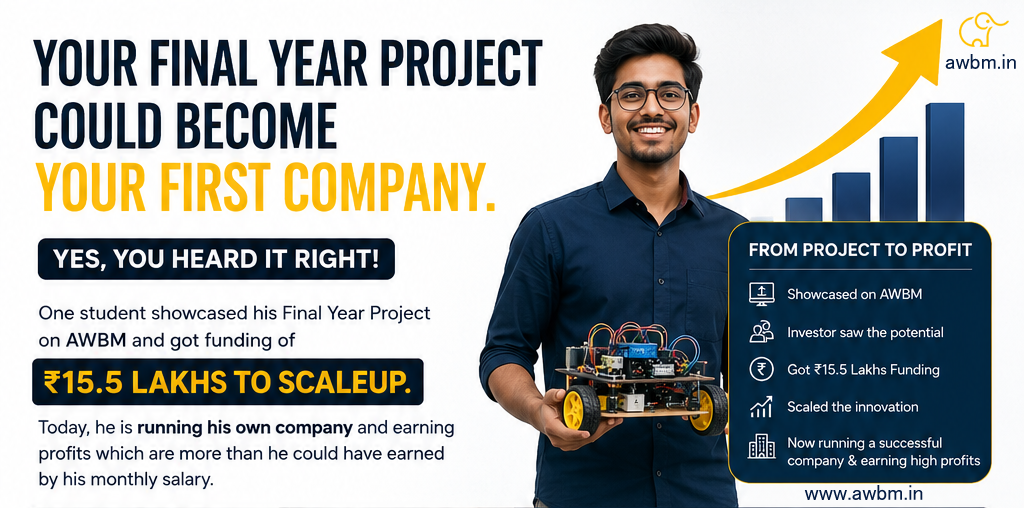
Aman got INR 15.5 Lakhs Funding
Learn More
CONTRIBUTION
SEEKING
DISTRIBUTION PARTNER
#166
Idea
Prototype
Market
Scaling
The simplest two-way automatic door latch.
VALUATION
Valuation Restricted
The simplest two-way automatic door latch.
This is a short video showing how to make an ex... The simplest two-way automatic door latch.
This is a short video showing how to make an extremely simple two-way automatic door latch.
This is a short video showing how to make an ex... The simplest two-way automatic door latch.
This is a short video showing how to make an extremely simple two-way automatic door latch.
READ MORE
OPEN REEL
TECH DISCUSSION
No technical queries yet.