

CONTRIBUTION
SEEKING
PARTNERSHIP
#70
Idea
Prototype
Market
Scaling
Brick Machine
VALUATION
Valuation Restricted
CONTRIBUTION
SEEKING
DISTRIBUTION PARTNER
#78
Idea
Prototype
Market
Scaling
DIY Solar Generator Is WAY More Powerful Than I Thought
VALUATION
Valuation Restricted
This video by Concept Crafted Creations serves as a follow-up test for a DIY solar generator insp...
This video by Concept Crafted Creations serves as a follow-up test for a DIY solar generator inspired by the James Webb Space Telescope. After receiving over 1,700 viewer comments, the creator addresses top suggestions to optimize the mirror array's performance and efficiency.
Key highlights and improvements include:
Precision Alignment: The creator abandoned standard laser pointers in favor of a 3D-printed housing with a high-power LED and magnifying glass to project a large, uniform red dot for aligning the 18 individual mirrors (5:50-6:06).
Sun Tracking: To solve issues with ambient light interference, a custom sleeve was printed for the LDR sensors to ensure more accurate tracking during clear days (4:52-5:45).
Refined Design: Based on viewer feedback, the creator removed the secondary mirror to prevent heat damage to components and painted the collector plate black to maximize heat absorption (6:29-7:16).
Test Results:
During the final test, the mirror array successfully heated 20 liters of water from 22.6°C to 44.2°C in 32 minutes (8:22-8:35). Despite a structural failure caused by wind that tipped the device, the calculated power output was approximately 924 Watts (just under 1 kW), demonstrating a surprisingly high efficiency of about 705 Watts per square meter (8:42-9:26). The creator concludes by inviting viewers to vote on whether to rebuild this version or design a more robust, weatherproof model.
Key highlights and improvements include:
Precision Alignment: The creator abandoned standard laser pointers in favor of a 3D-printed housing with a high-power LED and magnifying glass to project a large, uniform red dot for aligning the 18 individual mirrors (5:50-6:06).
Sun Tracking: To solve issues with ambient light interference, a custom sleeve was printed for the LDR sensors to ensure more accurate tracking during clear days (4:52-5:45).
Refined Design: Based on viewer feedback, the creator removed the secondary mirror to prevent heat damage to components and painted the collector plate black to maximize heat absorption (6:29-7:16).
Test Results:
During the final test, the mirror array successfully heated 20 liters of water from 22.6°C to 44.2°C in 32 minutes (8:22-8:35). Despite a structural failure caused by wind that tipped the device, the calculated power output was approximately 924 Watts (just under 1 kW), demonstrating a surprisingly high efficiency of about 705 Watts per square meter (8:42-9:26). The creator concludes by inviting viewers to vote on whether to rebuild this version or design a more robust, weatherproof model.
READ MORE
OPEN REEL
CONTRIBUTION
SEEKING
DISTRIBUTION PARTNER
#106
Idea
Prototype
Market
Scaling
Vertical Farming
VALUATION
Valuation Restricted
After having set up vertical farms using Tower Garden aeroponic systems in 30 countries on 5 cont...
After having set up vertical farms using Tower Garden aeroponic systems in 30 countries on 5 continents, let us share with you the main benefits of a Tower Farm:
1. 95% water savings in comparison to soil farming
2. 80% space savings in comparison to conventional hydroponics
3. Low energy footprint
4. Nutrient density: aeroponic crops grown on a Tower Garden feature an increase in nutrient density and antioxidant levels.
5. Less pesticides
6. Versatility: Tower Farms can be set up can be set up outdoors, in a greenhouse, indoors with LED lights, or even on a rooftop.
7. No previous experience is required to start a Tower Farm!
1. 95% water savings in comparison to soil farming
2. 80% space savings in comparison to conventional hydroponics
3. Low energy footprint
4. Nutrient density: aeroponic crops grown on a Tower Garden feature an increase in nutrient density and antioxidant levels.
5. Less pesticides
6. Versatility: Tower Farms can be set up can be set up outdoors, in a greenhouse, indoors with LED lights, or even on a rooftop.
7. No previous experience is required to start a Tower Farm!
READ MORE
OPEN REEL
SPONSORED INNOVATION
Fashion for everyone. Know your fabric quality before you order...
Learn More
CONTRIBUTION
SEEKING
RAW MATERIAL SUPPLIERS
#109
Idea
Prototype
Market
Scaling
Agriculture based Mechanical Projects / Agro Trimmer
VALUATION
Valuation Restricted
Agriculture based Mechanical Projects / Agro Trimmer

J
CONTRIBUTION
SEEKING
SKILL DEVELOPMENT
#217
Idea
Prototype
Market
Scaling
Learn about Talent Acquisition
VALUATION
Valuation Restricted
Talent acquisition is the strategic process of identifying, attracting, evaluating, and hiring sk...
Talent acquisition is the strategic process of identifying, attracting, evaluating, and hiring skilled individuals to meet an organization's long-term workforce needs. It encompasses employer branding, candidate experience, and building talent pipelines to ensure the right people are in the right roles at the right time.
READ MORE
OPEN REEL
CONTRIBUTION
SEEKING
PARTNERSHIP
#68
Idea
Prototype
Market
Scaling
Automatic screw capping machine
VALUATION
Valuation Restricted
SPONSORED INNOVATION
Aman got INR 15.5 Lakhs Funding
Learn More
CONTRIBUTION
SEEKING
DISTRIBUTION PARTNER
#120
Idea
Prototype
Market
Scaling
Turn My Bike into a Street Sweeper: Crazy DIY Experiment with 12 Spinning Brooms!
VALUATION
Valuation Restricted
\"In this crazy DIY experiment, I transformed my bike into a street sweeper by swapping out the f...
\"In this crazy DIY experiment, I transformed my bike into a street sweeper by swapping out the front wheel for 12 spinning brooms! Watch as I put this unique creation to the test—can it actually clean the streets as I ride? Check out the build process, the challenges, and the surprising results!\"
How this was made
How this was made
READ MORE
OPEN REEL
CONTRIBUTION
SEEKING
DISTRIBUTION PARTNER
#105
Idea
Prototype
Market
Scaling
LED 40×40 Pixel Display | DIY 40×40 Pixel Metrix
VALUATION
Valuation Restricted
How To Program ESP32 For 40×40 Pixel Display | DIY 40×40 Pixel Metrix
CONTRIBUTION
SEEKING
BRANDING & MARKETING
#128
Idea
Prototype
Market
Scaling
How to Make a Mini Electric Car (DIY)
VALUATION
Valuation Restricted
Hi friends today I am going to show you how to make a mini electric car at home.
This is a two... Hi friends today I am going to show you how to make a mini electric car at home.
This is a two-seater electric car. This electric car will be beneficial for going to the local market or office or traveling around 60 kilometers.
The material I have used -
1. 1'' Iron pipe and 1x2'' rectangular bar
2. 12-inch e-rickshaw wheel
3. 4 Rear Shock Absorber for Hero Glamour bike
4. Old car driver sit and steering
5. E Rickshaw Differential ,Motor
6. 60v ,32A li-ion Battery pack
7. 1000W ,Motor and ,controller,etc
8. Universal Steering Wheel for Sports Car
https://amzn.to/4h5VBWO
9. 5 inch Parking Camera
https://amzn.to/4iiMoeG
10. 3D Black Carbon Fiber
https://amzn.to/43bIAaP
https://amzn.to/3CY7Abb
Dimensions of the vehicle (Inches):
Total height from ground - 58''
The total length of structure - 90''
Length of base - 86''
Ground clearance - 7''
Width of the structure - 30''
The Welding machine I have used are
iBELL TIG-MMA Inverter Welding Machine -
https://amzn.to/44TfbPX
iBELL MAG/MMA Flux Cored Gasless Welding Machine -
https://amzn.to/3ovkyTG
you can get the machine here (With Battery)
Cordless Angle grinder- https://amzn.to/3W8vtne
Brushless impact wrench - https://amzn.to/3xFdyug
Brushless Jig saw - https://amzn.to/3W3TlIR
Thank you for watching .
This is a two... Hi friends today I am going to show you how to make a mini electric car at home.
This is a two-seater electric car. This electric car will be beneficial for going to the local market or office or traveling around 60 kilometers.
The material I have used -
1. 1'' Iron pipe and 1x2'' rectangular bar
2. 12-inch e-rickshaw wheel
3. 4 Rear Shock Absorber for Hero Glamour bike
4. Old car driver sit and steering
5. E Rickshaw Differential ,Motor
6. 60v ,32A li-ion Battery pack
7. 1000W ,Motor and ,controller,etc
8. Universal Steering Wheel for Sports Car
https://amzn.to/4h5VBWO
9. 5 inch Parking Camera
https://amzn.to/4iiMoeG
10. 3D Black Carbon Fiber
https://amzn.to/43bIAaP
https://amzn.to/3CY7Abb
Dimensions of the vehicle (Inches):
Total height from ground - 58''
The total length of structure - 90''
Length of base - 86''
Ground clearance - 7''
Width of the structure - 30''
The Welding machine I have used are
iBELL TIG-MMA Inverter Welding Machine -
https://amzn.to/44TfbPX
iBELL MAG/MMA Flux Cored Gasless Welding Machine -
https://amzn.to/3ovkyTG
you can get the machine here (With Battery)
Cordless Angle grinder- https://amzn.to/3W8vtne
Brushless impact wrench - https://amzn.to/3xFdyug
Brushless Jig saw - https://amzn.to/3W3TlIR
Thank you for watching .
READ MORE
OPEN REEL
SPONSORED INNOVATION

Recruitment Software - Applicant Tracking System
Learn More

DEMAND
SEEKING
MANUFACTURER
#189
Idea
Prototype
Market
Scaling
Universal Adaptive Contour Forming Machine for Metal Sheet Customization
VALUATION
Valuation Restricted
# Innovation Requirement: Universal Adaptive Contour Forming Machine for Metal Sheet Customizatio...
# Innovation Requirement: Universal Adaptive Contour Forming Machine for Metal Sheet Customization
## Problem Statement
The automotive modification industry, custom bike builders, fabrication workshops, appliance manufacturers, and prototype development companies face a common challenge:
Every unique metal shape requires a dedicated mold, die, or tooling setup.
Traditional manufacturing methods involve:
* Expensive die manufacturing
* Long setup times
* High tooling costs
* Storage of multiple molds
* Limited flexibility for custom jobs
* Economically unviable low-volume production
For example, when a car modifier needs a custom fender, dashboard panel, door contour, bike tank cover, or decorative metal component, a dedicated mold must be created before production begins.
This increases both development time and cost.
---
## Proposed Innovation
### Universal Adaptive Contour Forming Machine
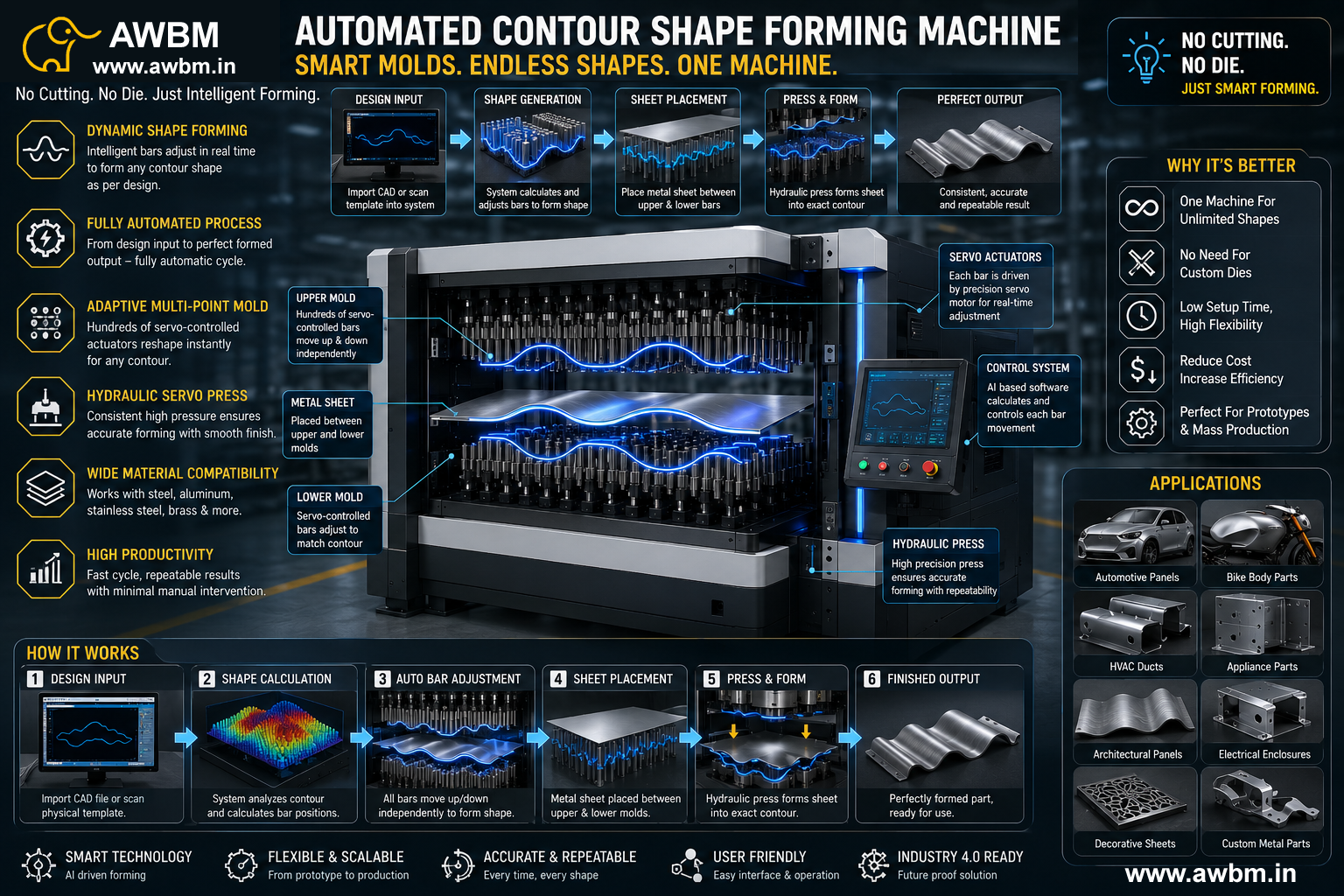
A smart metal-forming machine capable of automatically creating any contour shape without requiring dedicated molds.
The concept is inspired by a contour gauge shape duplicator but scaled into an industrial automated machine.
Instead of fixed molds, the machine contains:
### Upper Adaptive Mold
Hundreds or thousands of independently movable pins/bars arranged in a grid.
### Lower Adaptive Mold
A matching grid of servo-controlled pins/bars positioned opposite the upper mold.
When a design is entered into the system:
1. CAD file is imported.
2. Software converts the contour into pin coordinates.
3. Each upper and lower bar automatically moves to a specific height.
4. Together they create a temporary mold matching the desired shape.
5. Metal sheet is placed between both adaptive surfaces.
6. Hydraulic/servo press applies force.
7. Sheet permanently forms into the required contour.
8. System resets for the next design.
No dedicated die is required.
---
## Working Principle
### Step 1 – Design Input
User imports:
* CAD file
* 3D scan
* DXF
* STEP
* STL
* Physical template scan
### Step 2 – Shape Conversion
Software analyzes:
* Curvature
* Surface profile
* Height variation
* Bend requirements
### Step 3 – Adaptive Mold Generation
AI/Control software calculates position of every bar.
Example:
If machine contains:
* 2,500 upper bars
* 2,500 lower bars
Then all 5,000 bars automatically reposition themselves to create the required shape.
### Step 4 – Sheet Loading
Metal sheet is inserted between adaptive molds.
Supported materials:
* Mild steel
* Stainless steel
* Aluminum
* Brass
* Copper
* Composite sheets
### Step 5 – Forming
Hydraulic or servo press applies pressure.
Adaptive bars transfer the contour into the sheet.
### Step 6 – Output
Finished customized component is produced.
System becomes ready for next design.
---
## Key Innovation Areas
### Adaptive Pin Technology
Independent servo-controlled bars.
### AI Shape Translation Engine
Converts CAD geometry into pin coordinates.
### Real-Time Mold Reconfiguration
Automatic setup within minutes.
### Smart Pressure Control
Material-specific forming parameters.
### Design Library
Store and recall thousands of designs.
### Industry 4.0 Integration
Cloud-based monitoring and analytics.
---
## Potential Applications
### Automotive
* Fender modification
* Bonnet contours
* Door panels
* Interior trims
* Body kits
### Motorcycle Industry
* Fuel tank panels
* Side covers
* Mudguards
* Custom fairings
### Aerospace
* Lightweight panels
* Prototype components
### Architecture
* Decorative metal facades
* Custom wall panels
### Appliances
* Washing machine panels
* Refrigerator parts
### Furniture
* Designer metal products
### Prototyping Industry
* Rapid manufacturing
---
## Expected Benefits
### Cost Reduction
Eliminates need for dedicated molds.
### Faster Production
Setup time reduced from days/weeks to minutes.
### Mass Customization
Every piece can have a different design.
### Lower Investment
One machine replaces hundreds of dies.
### Sustainable Manufacturing
Reduced tooling waste.
### Higher Innovation
Enables small manufacturers to create complex designs.
---
## Prototype Requirement
### Phase 1 – Proof of Concept
Machine Size:
500 mm × 500 mm
Features:
* 100–400 movable bars
* Servo-controlled movement
* Basic CAD import
* Manual sheet loading
* Low-pressure forming
Objective:
Validate adaptive contour generation.
### Phase 2 – Functional Prototype
Machine Size:
1000 mm × 1000 mm
Features:
* 1,000+ adaptive bars
* Automated shape generation
* Hydraulic pressing
* Touchscreen control
Objective:
Create real automotive and bike panels.
### Phase 3 – Commercial Product
Machine Size:
Customizable
Features:
* 5,000–20,000 adaptive bars
* AI-driven contour optimization
* Industrial production capability
* Multi-material support
---
## Seeking Innovators
We are looking for:
* Mechanical Engineers
* Mechatronics Engineers
* Robotics Experts
* Industrial Automation Specialists
* CNC Machine Designers
* Hydraulic System Designers
* AI/Control System Developers
* Manufacturing Startups
* Research Institutions
* Prototype Development Teams
The goal is to develop the world\\\\\\'s first commercially viable Universal Adaptive Contour Forming Machine capable of transforming digital designs directly into metal sheet contours without dedicated dies or molds.
Status: Concept Seeking Innovators, Technical Partners, Prototype Developers and Investors.
## Problem Statement
The automotive modification industry, custom bike builders, fabrication workshops, appliance manufacturers, and prototype development companies face a common challenge:
Every unique metal shape requires a dedicated mold, die, or tooling setup.
Traditional manufacturing methods involve:
* Expensive die manufacturing
* Long setup times
* High tooling costs
* Storage of multiple molds
* Limited flexibility for custom jobs
* Economically unviable low-volume production
For example, when a car modifier needs a custom fender, dashboard panel, door contour, bike tank cover, or decorative metal component, a dedicated mold must be created before production begins.
This increases both development time and cost.
---
## Proposed Innovation
### Universal Adaptive Contour Forming Machine
A smart metal-forming machine capable of automatically creating any contour shape without requiring dedicated molds.
The concept is inspired by a contour gauge shape duplicator but scaled into an industrial automated machine.
Instead of fixed molds, the machine contains:
### Upper Adaptive Mold
Hundreds or thousands of independently movable pins/bars arranged in a grid.
### Lower Adaptive Mold
A matching grid of servo-controlled pins/bars positioned opposite the upper mold.
When a design is entered into the system:
1. CAD file is imported.
2. Software converts the contour into pin coordinates.
3. Each upper and lower bar automatically moves to a specific height.
4. Together they create a temporary mold matching the desired shape.
5. Metal sheet is placed between both adaptive surfaces.
6. Hydraulic/servo press applies force.
7. Sheet permanently forms into the required contour.
8. System resets for the next design.
No dedicated die is required.
---
## Working Principle
### Step 1 – Design Input
User imports:
* CAD file
* 3D scan
* DXF
* STEP
* STL
* Physical template scan
### Step 2 – Shape Conversion
Software analyzes:
* Curvature
* Surface profile
* Height variation
* Bend requirements
### Step 3 – Adaptive Mold Generation
AI/Control software calculates position of every bar.
Example:
If machine contains:
* 2,500 upper bars
* 2,500 lower bars
Then all 5,000 bars automatically reposition themselves to create the required shape.
### Step 4 – Sheet Loading
Metal sheet is inserted between adaptive molds.
Supported materials:
* Mild steel
* Stainless steel
* Aluminum
* Brass
* Copper
* Composite sheets
### Step 5 – Forming
Hydraulic or servo press applies pressure.
Adaptive bars transfer the contour into the sheet.
### Step 6 – Output
Finished customized component is produced.
System becomes ready for next design.
---
## Key Innovation Areas
### Adaptive Pin Technology
Independent servo-controlled bars.
### AI Shape Translation Engine
Converts CAD geometry into pin coordinates.
### Real-Time Mold Reconfiguration
Automatic setup within minutes.
### Smart Pressure Control
Material-specific forming parameters.
### Design Library
Store and recall thousands of designs.
### Industry 4.0 Integration
Cloud-based monitoring and analytics.
---
## Potential Applications
### Automotive
* Fender modification
* Bonnet contours
* Door panels
* Interior trims
* Body kits
### Motorcycle Industry
* Fuel tank panels
* Side covers
* Mudguards
* Custom fairings
### Aerospace
* Lightweight panels
* Prototype components
### Architecture
* Decorative metal facades
* Custom wall panels
### Appliances
* Washing machine panels
* Refrigerator parts
### Furniture
* Designer metal products
### Prototyping Industry
* Rapid manufacturing
---
## Expected Benefits
### Cost Reduction
Eliminates need for dedicated molds.
### Faster Production
Setup time reduced from days/weeks to minutes.
### Mass Customization
Every piece can have a different design.
### Lower Investment
One machine replaces hundreds of dies.
### Sustainable Manufacturing
Reduced tooling waste.
### Higher Innovation
Enables small manufacturers to create complex designs.
---
## Prototype Requirement
### Phase 1 – Proof of Concept
Machine Size:
500 mm × 500 mm
Features:
* 100–400 movable bars
* Servo-controlled movement
* Basic CAD import
* Manual sheet loading
* Low-pressure forming
Objective:
Validate adaptive contour generation.
### Phase 2 – Functional Prototype
Machine Size:
1000 mm × 1000 mm
Features:
* 1,000+ adaptive bars
* Automated shape generation
* Hydraulic pressing
* Touchscreen control
Objective:
Create real automotive and bike panels.
### Phase 3 – Commercial Product
Machine Size:
Customizable
Features:
* 5,000–20,000 adaptive bars
* AI-driven contour optimization
* Industrial production capability
* Multi-material support
---
## Seeking Innovators
We are looking for:
* Mechanical Engineers
* Mechatronics Engineers
* Robotics Experts
* Industrial Automation Specialists
* CNC Machine Designers
* Hydraulic System Designers
* AI/Control System Developers
* Manufacturing Startups
* Research Institutions
* Prototype Development Teams
The goal is to develop the world\\\\\\'s first commercially viable Universal Adaptive Contour Forming Machine capable of transforming digital designs directly into metal sheet contours without dedicated dies or molds.
Status: Concept Seeking Innovators, Technical Partners, Prototype Developers and Investors.
READ MORE
OPEN REEL
TECH DISCUSSION
No technical queries yet.